There's a moment most team leads and HR managers recognise — but rarely name.
A project stalls because the one person who knows the system is unavailable. A new hire is onboarded into a role that partially duplicates what someone else already does brilliantly. A promotion round arrives and nobody can quite agree on who's actually ready. A client asks if your team has a specific capability, and someone has to go around asking before they can answer.
None of these moments feel like a crisis. They feel like friction. Normal friction. The kind you just absorb and move on from.
But that friction has a name: skills blindness — and it compounds quietly until it becomes a real cost.
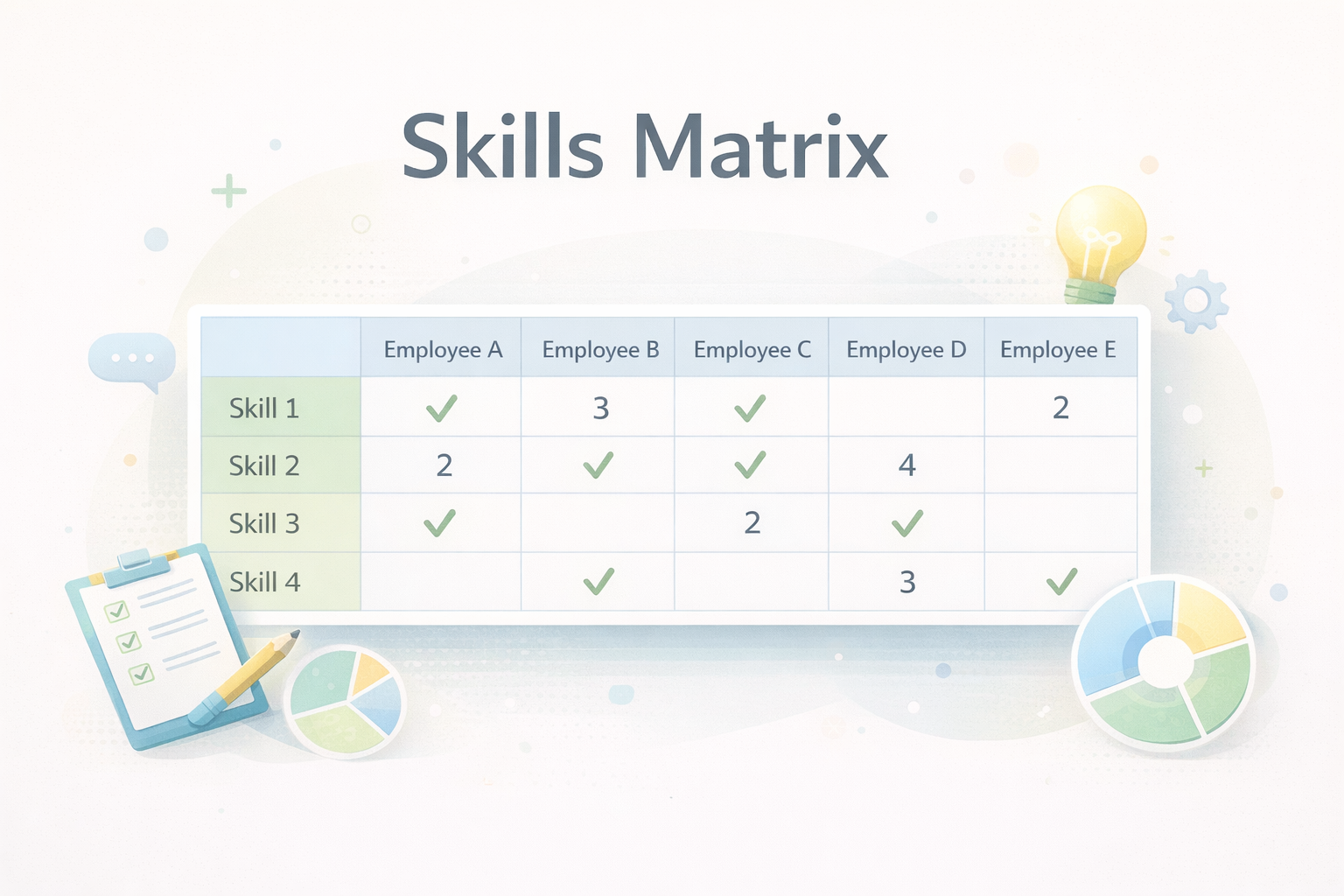
The solution isn't hiring more people or running another survey. It's building a structured, real-time picture of what your team can actually do. That's what a skills matrix does. And the question isn't whether you need one — it's whether you're already showing the signs that you do.
Here are five of them.
Sign 1: You rely on the same people for everything
You know who they are. The person everyone goes to when there's a tricky technical problem. The one who somehow always ends up running the client calls. The teammate who quietly holds the institutional knowledge that would take six months to replace.
Every team has these people. The problem isn't that they're talented — it's that their talent is invisible to the organisation until it's needed. When they're on holiday, things slow down. When they leave, things break. When you need to scale a project, you realise you only have one of them.
This is what dependency risk looks like, and it's one of the most common — and costly — signs that your team lacks skills visibility.
95% of organisations struggle to find skilled talent, with skills gaps representing the main hiring bottleneck. But here's what many leaders miss: the talent they need is often already in the room. They just can't see it.
A skills matrix maps capability across the whole team — not just who's loudest in meetings, or who's been there longest, but who can actually do what, at what level of proficiency. It surfaces the quiet expert in the corner and the emerging talent who's ready for more responsibility.
Ask yourself: If your top three performers were unavailable tomorrow, would you know exactly who could cover their core responsibilities?
Sign 2: Project staffing is based on gut feel, not data
How do you decide who goes on which project?
If the answer involves a mental Rolodex, a quick chat in the corridor, or defaulting to whoever isn't currently slammed — you're making resourcing decisions based on availability and familiarity rather than fit.
This matters more than it sounds. Mismatched resourcing doesn't just reduce project quality. It burns out the overloaded and disengages the underutilised. It sends the wrong person into a client conversation. It creates bottlenecks that could have been avoided.
A skills matrix replaces "I think we have that skill" with a shared, trackable view of capability across teams — turning a guess into a decision grounded in data.
Instead of "who's free?", the question becomes "who's the right fit, and who's ready to stretch into this?" That shift alone changes the quality of decisions made in every sprint planning session, every proposal, every hire.
Ask yourself: When you last staffed a project, could you confidently say you picked the best-matched people — or just the most available ones?
Sign 3: You're hiring for skills you already have
This one stings a little.
You post a job, interview candidates, onboard someone new — and six months later, a colleague mentions offhand that they've been doing exactly that kind of work for years. At their last company. Or on the side. Or in a project that never got properly documented.
Redundant hiring is expensive. The average cost of a mis-hire sits between 1–3x the role's annual salary when you factor in recruitment, onboarding, and lost productivity. But more than the cost, it signals something deeper: you don't have a reliable map of what your existing team brings to the table.
The mean percentage of jobs with skills mapped has grown to 72%, up from 69% in 2023 — demonstrating rising maturity in skills adoption and laying the groundwork for more effective talent strategies. The organisations driving that number aren't doing it out of HR idealism. They're doing it because it saves money and makes better use of the people they already employ.
A skills matrix turns your workforce into a searchable, structured asset. Before you post a job, you can ask: do we already have this capability? Could we develop it internally? Is this a genuine gap or a visibility gap?
Ask yourself: In the last year, have you hired for a skill that someone already on your team had — but you didn't know about?
Sign 4: Career development conversations are vague and reactive
"We'll find something for you." "Keep doing what you're doing." "Let's revisit this in your next review."
Vague career conversations aren't just demoralising — they're a retention risk. Organisations that fail to map, measure, and act on skills risk losing top talent, falling behind competitors, and seeing productivity decline.
When development is reactive rather than structured, two things happen. High performers who want clarity about their growth path start looking elsewhere. And managers, without a clear picture of where each person's skills sit relative to where they need to go, default to generic advice that doesn't land.
A skills matrix gives development conversations a foundation. Instead of a vague chat, a manager and employee can look at the same data: here's where you are, here are the skills required for the next level, here's the specific gap we're working on together. That's not just more useful — it's the kind of clarity that drives engagement.
65% of employers have now adopted skills-based hiring practices, and the same logic applies internally. Employees want to know their career progression is based on what they can do, not on politics or tenure.
Ask yourself: Could each member of your team tell you exactly what skills they need to develop to reach their next level — and could you back that up with data?
Sign 5: You can't answer "what can our team do?" with confidence
This is the most telling sign of all.
A prospective client asks what your team's capabilities are. A board member wants to know if you're ready to deliver on a new strategic direction. A partner asks whether your team has the bandwidth and the skills to take on a joint project.
If the honest answer is "I'd have to check around", that's the moment skills blindness becomes a business problem.
80% of US organisations already use workforce planning and skills documentation in some form. But there's a significant gap between having some documentation and having a live, queryable picture of team capability that you can actually act on.
The leaders who can answer that question confidently — who can pull up a skills view in a meeting, make an informed resourcing call on the spot, or plan a quarter's hiring against a known capability map — are operating at a different level. Not because they're smarter, but because they've built the infrastructure to see clearly.
Ask yourself: If someone asked you right now to describe your team's top five capabilities and your three biggest skill gaps, how long would it take you to give a confident, accurate answer?
What to do next
If you recognised your team in two or more of these signs, you're not behind — you're just at the start of a journey that most growing organisations arrive at eventually.
The first step isn't a big technology project. It's a decision: to stop managing capability by intuition and start managing it by design.
A skills matrix is the foundation. And the right platform makes building and maintaining that foundation far simpler than most teams expect — with the added benefit of AI-powered insights that surface what a spreadsheet never could.
At Cosmokode, we built PSM precisely for this moment — the point where a team is growing fast enough that gut feel stops working, but hasn't yet had the tools to replace it with something better. PSM gives you real-time skills tracking, AI-powered talent recommendations, and the kind of visibility that turns capability into a competitive advantage.
👉 Explore PSM →
Enjoyed this article? Share it with a team lead or HR manager who's been feeling that friction — they'll know exactly what you mean.